- Home
- Company Profile
-
Our Products
- Basmati Rice for Global Buyers & Importers
- Non-Basmati Rice – Bulk Supply for Global Importers & B2B Buyers
- Pulses – Global Bulk Supply for B2B Buyers & Importers
- Jaggery Suppliers for Bulk B2B Buyers
- Honey for Global Buyers & Importers
- Sesame Seeds Suppliers for Bulk Buyers
- Sweet Corn for Bulk Buyers
- Makhana Suppliers for Bulk Buyers
- Frozen Peas for Global Buyers & Importers
- Blogs
- Contact Us

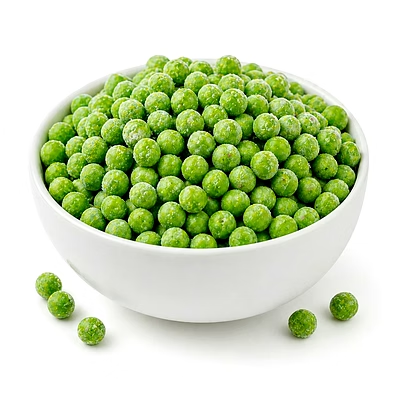

Green Pees (MATAR FROZEN ) Frozen Peas by Dattatray for international frozen food importers
-
Product is not available
Brand:
Country Of Origin : India
IQF Frozen Green Peas for Ready Meals & Frozen Mixes
IQF Frozen Green Peas are blanched and individually quick frozen to retain color, texture and cell integrity for use in ready meals, frozen vegetable blends and foodservice applications. Buyers include frozen-mix formulators and HORECA procurement teams that require low thaw-drip, uniform particle size and documented cold-chain handling.
Product is supplied in refrigerated cartons, organized for reefer container transport with temperature logs and lot COA. Typical packing formats are 10–20kg poly-bags in cartons; private labeling into retail bags is available for approved volumes.
Quality Parameters & Cold-Chain Tolerances
- IQF Status: Individually Quick Frozen after blanching (process-controlled)
- Blanching: Time-temperature controlled for color and enzyme inactivation (batch-verified)
- Storage Temp: -18°C recommended for shelf stability (Export Standard)
- Microbiological: Process hygiene monitoring and lot COA provided
Packaging & Logistics
- MOQ & Load Sizing: Reefer containers for FCL; consolidated LCL options for smaller volumes
- Lead Time & Fulfillment: Dispatch aligned with reefers and port sailing schedules; temp logs accompany shipments
- Supply Authority: HACCP controlled IQF lines and cold-storage facilities
- Packaging Formats: 10kg/20kg sealed poly-bags in insulated cartons; shrink-wrapped pallets for reefers
Food Formulation & Processing Suitability
Target users include frozen-mix manufacturers, ready-meal assemblers and institutional kitchens. Blanching parameters influence enzyme inactivation and subsequent color retention; shorter blanching preserves firmness but may increase enzyme activity, so balance is set by target end-use. IQF peas with consistent particle size reduce segregation in mixes and improve portion control on automated lines.
Cold-Chain Infrastructure & Export Documentation
- Infrastructure & QA: IQF tunnels, metal detection, cold-storage warehousing and temperature loggers for each lot
- Country of Origin: India
- Port of Loading: Major local ports (e.g., Mundra / Nhava Sheva)
- Documents Provided: Batch-wise COA, Temperature Logs, Commercial Invoice and Packing List
Processing Insight: Blanch & Freeze Impact on Thaw Loss
Thaw-drip loss is driven by cell-wall damage during blanching and freezing. Optimal blanch time balances enzyme inactivation and minimal cell rupture; freeze rates that achieve rapid core solidification reduce ice crystal growth and limit drip on thaw. For manufacturers, request process logs to validate expected thaw yield in your application.
Request a Procurement Quote | Cold-Chain Validation
Provide required pack sizes, annual volume and target port to receive temperature logs, COA samples and reefer loading plans.
Semantic Internal Linking & Categories
Related Commodities & Capabilities:
- IQF Sweet Corn, Frozen Vegetable Blends
- Private Label Retail Bags, Custom Mix Formulation
Explore Category:
- IQF Frozen Vegetables for Food Manufacturing
Frequently Asked Questions
- What is the recommended storage temperature and expected shelf life? Store at -18°C; shelf life depends on storage chain but is managed through IQF handling and temp logs supplied per shipment.
- How is thaw-drip minimized? Rapid freezing to limit ice crystal size and controlled blanching reduce cell rupture and subsequent drip on thaw.
- What container types are used for shipment? Reefer containers for FCL shipments and insulated, palletized cartons with temperature logging for refrigerated integrity.
- Are process logs and COA provided? Yes. Batch COA and temperature logs accompany each shipment to validate cold-chain compliance.
